
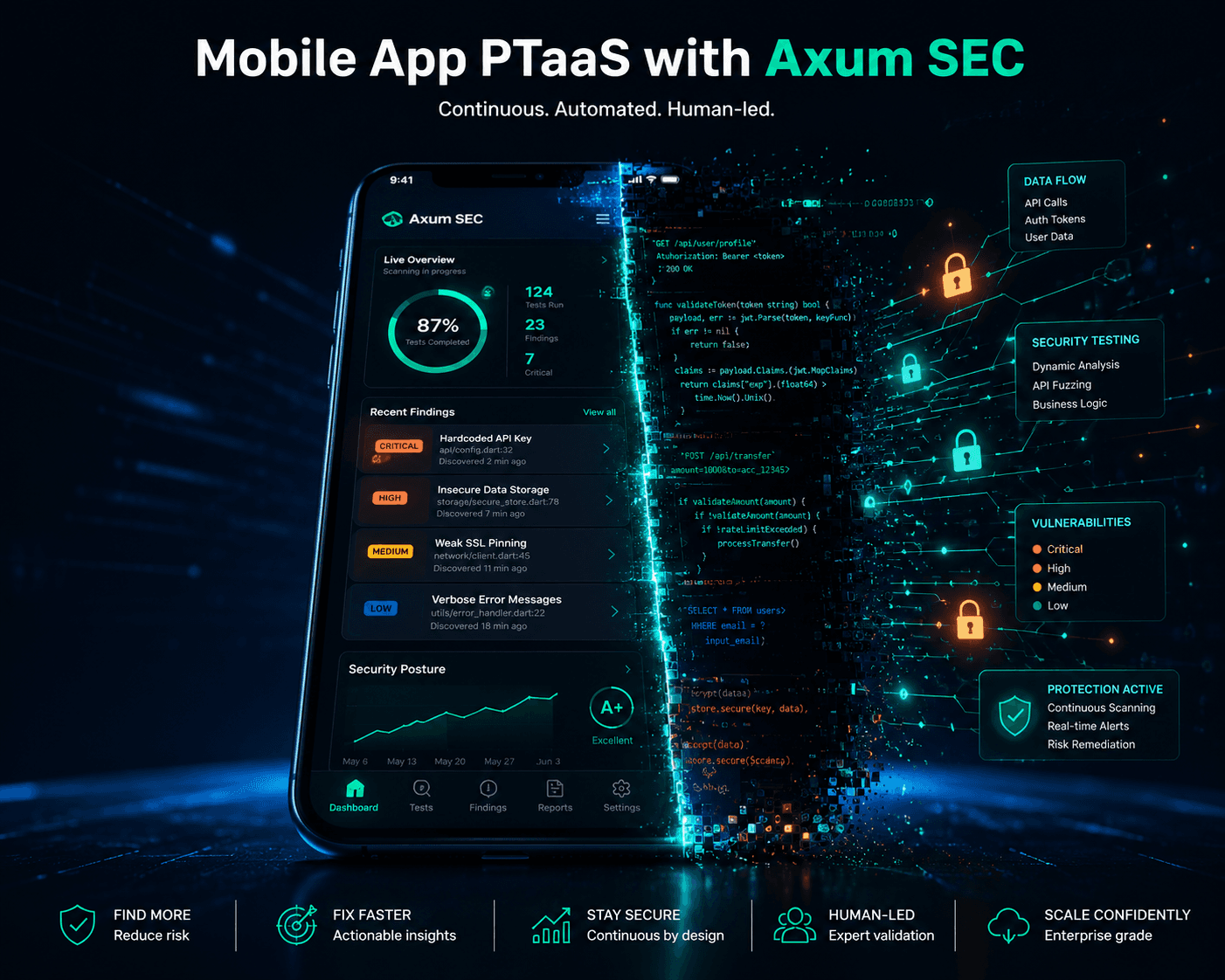
Mobile App Security in the Age of Continuous Threats: A Hands-On Guide to Pentesting with Axum SEC PTaaS
Your company just shipped a new mobile banking app. It passed QA. It looks beautiful. It's live on the App Store and Google Play. But when was the last time someone actually tried to break it?
Your company just shipped a new mobile banking app. It passed QA. It looks beautiful. It's live on the App Store and Google Play. But when was the last time someone actually tried to break it?
The Mobile Blind Spot
Your company just shipped a new mobile banking app. It passed QA. It looks beautiful. It's live on the App Store and Google Play. But when was the last time someone actually tried to break it?
For most organizations, mobile app security testing happens once — maybe during a pre-launch compliance checklist, maybe never at all. The app ships, and security becomes a memory. Meanwhile, attackers don't stop. They reverse-engineer your APK, intercept your API calls, and find the business logic flaw that lets them transfer funds they don't own.
This is where Penetration Testing as a Service (PTaaS) changes the game — and specifically, Axum SEC's PTaaS platform, designed to make continuous, on-demand security testing accessible, not just a luxury for Fortune 500 companies.
In this post, I'll walk you through what it actually looks like to test a mobile application using Axum SEC's PTaaS, why the continuous model matters, and how it transforms security from a snapshot into a living defense strategy.
What Makes Axum SEC Different? (And Why PTaaS Matters for Mobile)
Before we dive into the hands-on part, let's frame the problem Axum SEC is solving — because it's not just about finding bugs.
Traditional pentesting for mobile apps goes like this: you hire a consultancy once a year, they test an app version that's already outdated, and six weeks later you get a PDF full of CVEs with no context on which ones actually matter. It's a compliance checkbox. It doesn't make you safer.
Axum SEC's PTaaS model flips this on its head:
| Traditional Pentest | Axum PTaaS |
|---|---|
| Once a year | Continuous / On-Demand |
| PDF delivered weeks later | Real-time dashboard |
| No remediation help | Direct communication with testers |
| Static snapshot | Dynamic vulnerability lifecycle |
| Manual, siloed | Integrates with Jira, Slack, GitHub, CI/CD |
For a mobile app that updates every two weeks, the traditional model is broken the moment the PDF arrives. Axum SEC's approach means security testing keeps pace with your release cycle.
Step-by-Step: Testing a Mobile App with Axum SEC PTaaS
Let's walk through a realistic scenario. You're a security lead at a fintech company with an Android banking app. You suspect there may be vulnerabilities in the API layer and the local data storage. Here's how you'd engage Axum SEC.
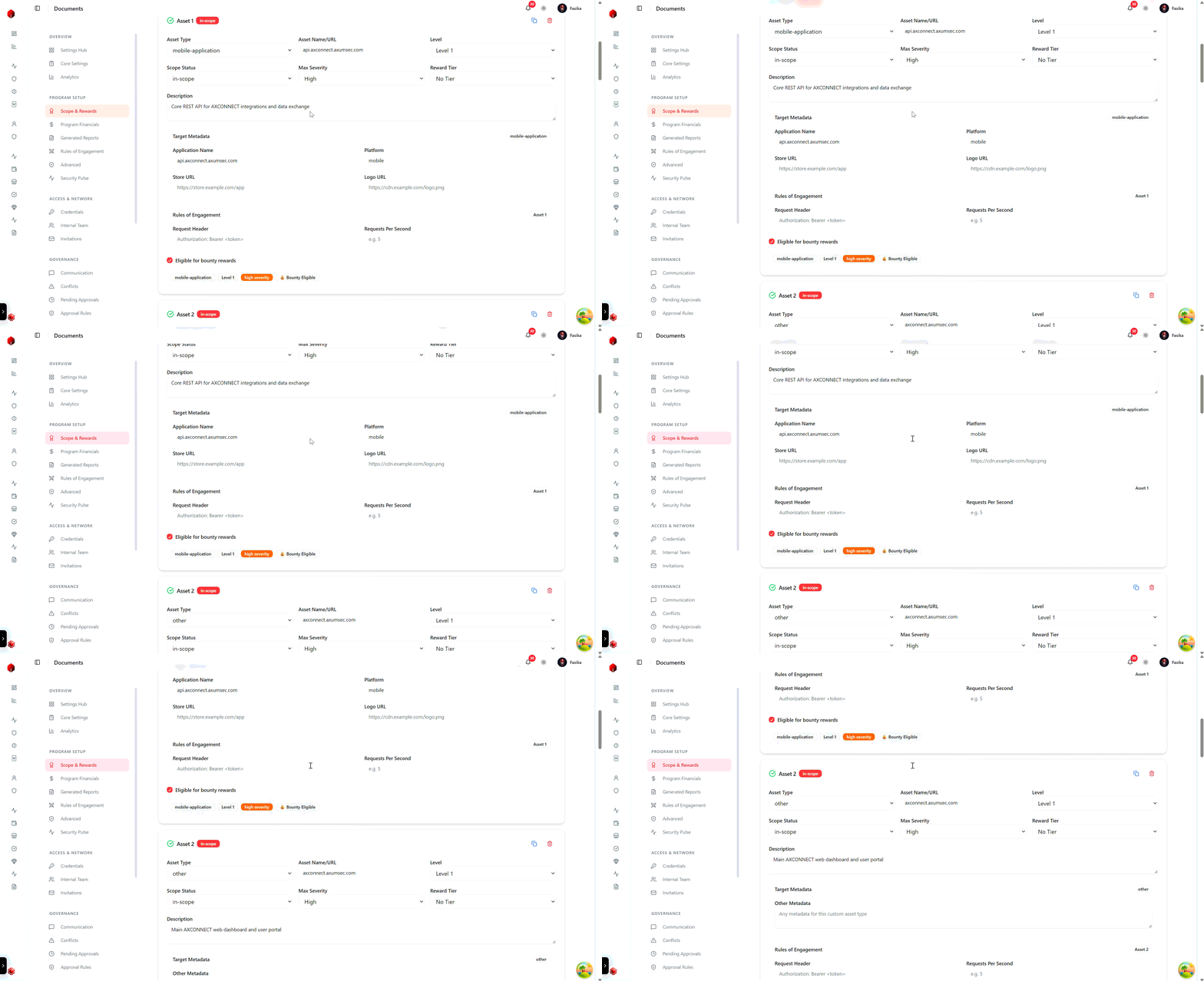
Step 1: Define the Scope
The first step in Axum SEC's methodology is scoping. Within the platform, you specify:
- The mobile application: Android (APK), iOS (IPA), or both
- The backend APIs: The endpoints the mobile app communicates with
- Authentication credentials: Test user accounts with various privilege levels
- Testing boundaries: Production vs. staging, IP ranges, excluded areas
Axum SEC's team works with you to translate your business needs into a scoped engagement. For our fintech app, the scope includes the Android APK, the /api/v2/ REST endpoints, and a test account with "user" role (not admin).
Step 2: Intelligence Gathering and Reconnaissance
Once scoped, Axum SEC's experts begin gathering intelligence. This phase is crucial for mobile apps because the attack surface extends beyond the app itself:
- APK decompilation: Extracting the manifest, hardcoded API keys, and endpoint URLs from the compiled app
- API mapping: Cataloging every endpoint the app calls, including undocumented ones
- Third-party SDK analysis: Identifying outdated or vulnerable libraries bundled in the app
- Certificate pinning checks: Testing whether the app properly validates TLS certificates or is vulnerable to man-in-the-middle interception
Within the Axum SEC Project Workspace, you can see this phase move from "Pending" to "Active" to "Done" on the board, with clear milestones attached. You're not wondering what's happening — you can watch the progress.
Step 3: Vulnerability Identification
This is where the deep technical work happens. For a mobile app, the Axum SEC team tests across multiple layers:
Client-Side (The APK/IPA):
- Insecure local data storage (plaintext credentials in SharedPreferences or SQLite databases)
- Improper WebView configurations allowing JavaScript injection
- Debuggable flags left enabled in production builds
- Hardcoded secrets (API tokens, encryption keys, cloud credentials)
Network Layer:
- Missing or improperly implemented certificate pinning
- Sensitive data transmitted over HTTP instead of HTTPS
- API endpoints vulnerable to IDOR (Insecure Direct Object Reference) — can User A access User B's data?
API and Backend:
- Authentication bypasses and token manipulation
- Business logic flaws (e.g., negative value transfers, race conditions)
- Injection vulnerabilities in API parameters
All findings appear in the real-time dashboard as they're discovered — not weeks later in a PDF. You can see severity, affected components, and initial remediation guidance immediately.
13131.png](https://resox.axumsec.com/uploads/1778524315265-310456010-screenshot-2026-05-11-213131.png)
Step 4: Controlled Exploitation
Axum SEC's ethical hackers then attempt to exploit validated vulnerabilities to assess real-world impact. For our banking app, this might mean:
- Proving they can extract session tokens from local storage and replay them
- Demonstrating an IDOR that reveals other users' transaction histories
- Showing that the app accepts a modified API response that changes the account balance display
Crucially, Axum SEC's team operates under safe exploitation rules — no destructive actions, no data exfiltration beyond what's needed to prove the point. This is the "ethical" in ethical hacking.
Step 5: Reporting, Remediation, and Retesting
Here's where Axum SEC's PTaaS model really shines over traditional pentesting.
Instead of a static PDF, you get:
-
A board-based Project Workspace where each finding is a trackable item with clear ownership. You assign "Fix the insecure local storage issue" to your Android developer, and it moves through states: Pending → Active → Done.
-
Direct communication with the testers. Your developer can ask, "Is encrypting SharedPreferences with EncryptedSharedPrefs sufficient, or do we need the Android Keystore?" and get an answer, not guess.
-
Integrated workflows. If your team uses Jira, the findings sync automatically. Slack notifications fire when a critical vulnerability is reported. Your CI/CD pipeline can trigger a retest on the next build.
-
Retest and certification. Once your team fixes the issues, Axum SEC retests and can issue a certification letter — useful for compliance with SOC 2, PCI DSS, or client security questionnaires.
The Continuous Advantage: Why One Test Isn't Enough
Mobile apps are living products. Every two-week sprint adds features, changes APIs, and introduces new third-party libraries. A pentest from March doesn't protect you in June.
With Axum SEC's Enterprise plan, testing is continuous. This means:
- Every significant release triggers a targeted retest
- The vulnerability lifecycle is dynamic, not a snapshot
- Your security posture trends over time — are you getting better or worse?
- The Insights dashboard surfaces risk patterns and severity trends, helping you prioritize strategically
Imagine an internal dashboard that tells your CISO: "Our mobile app's API vulnerability density dropped 40% over the last quarter, but we're seeing a new trend in client-side data storage issues." That's data-driven security, not guesswork.
Who This Is For (And Who It Isn't)
Let's break down Axum SEC's pricing tiers practically:
-
Essential ($0/month — likely a starting/limited tier): Good for a single web app with basic reporting. Not sufficient for a production mobile app with a serious security need.
-
Professional ($0/month — likely the practical entry point): Quarterly tests, API testing, real-time dashboard, 24-hour report turnaround. The sweet spot for startups and growing companies with 3–5 customer-facing apps.
-
Enterprise (custom): Continuous testing, unlimited apps and APIs, dedicated team, compliance assistance. For organizations where security downtime means reputational or financial disaster.
For a mobile-first company, the Professional tier is realistically where you start getting value — the API security testing alone is worth it, given how much of mobile app security is really about the backend.
Axum SEC's PTaaS doesn't just modernize penetration testing — it makes it a living part of your development lifecycle. For mobile applications, where the attack surface spans the client, the network, and the API layer, this continuous, integrated approach is not a luxury. It's the difference between hoping you're secure and knowing you are — right now, not six months ago when that PDF report was written.
If you're responsible for a mobile app that handles user data, financial transactions, or anything that would make headlines if breached, it's worth taking Axum SEC for a test drive.
Ready to move from annual checklists to continuous defense? Request a Penetration Test on Axum SEC's website →