
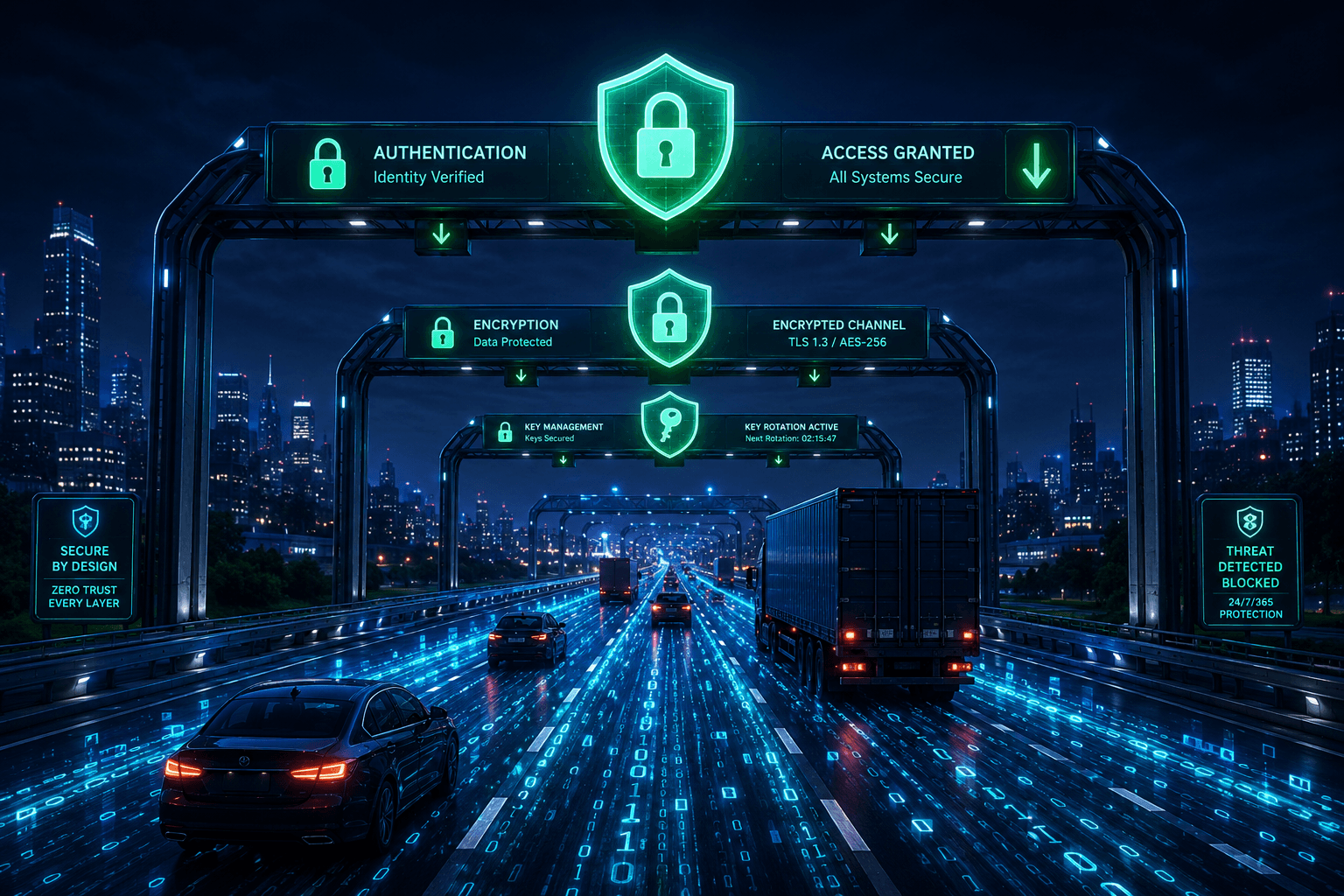
Securing the Fast Lane: An In-Depth Technical Guide to RFID ETC System Security
Every time you drive through a toll gantry at highway speeds, a silent, complex cryptographic handshake occurs in milliseconds. Your vehicle's RFID tag and the roadside reader exchange encrypted messages, verify identities, and authorize a financial transaction—all before you've had time to blink. This seamless experience masks a sophisticated security infrastructure designed to protect both your privacy and the toll authority's revenue. This guide explores RFID Electronic Toll Collection (ETC) security from the ground up—starting with the basic components that make it work, then diving deep into the cryptographic protocols, standards, and countermeasures that secure billions of annual transactions worldwide.
Every time you drive through a toll gantry at highway speeds, a silent, complex cryptographic handshake occurs in milliseconds. Your vehicle's RFID tag and the roadside reader exchange encrypted messages, verify identities, and authorize a financial transaction—all before you've had time to blink. This seamless experience masks a sophisticated security infrastructure designed to protect both your privacy and the toll authority's revenue. This guide explores RFID Electronic Toll Collection (ETC) security from the ground up—starting with the basic components that make it work, then diving deep into the cryptographic protocols, standards, and countermeasures that secure billions of annual transactions worldwide.
From Simple Tags to Cryptographic Fortresses
Part 1: The Foundation — Understanding ETC System Architecture
1.1 What is an RFID ETC System?
An Electronic Toll Collection (ETC) system uses Radio Frequency Identification (RFID) technology to automatically identify vehicles and process toll payments without requiring vehicles to stop. The system consists of three primary components:
| Component | Description | Security Relevance |
|---|---|---|
| RFID Tag (Transponder) | Mounted on vehicle windshield or license plate; stores unique identifier and account data | Primary target for cloning and eavesdropping |
| RFID Reader (RSU) | Installed on overhead gantries or at toll plazas; communicates with tags passing through | Trusted endpoint that must authenticate itself to tags |
| Back-End System | Central servers processing transactions, managing accounts, and detecting violations | Critical infrastructure requiring database security and audit logging |
1.2 The Tolling Transaction Flow
A complete ETC transaction involves several security-critical steps:
- Vehicle Detection — Sensors detect approaching vehicle and wake up the reader
- Tag Activation — Reader emits RF signal to power passive tags
- Mutual Authentication — Tag and reader verify each other's legitimacy
- Data Exchange — Tag transmits encrypted ID and account information
- Transaction Processing — Back-end validates account and deducts toll
- Violation Enforcement — ALPR cameras capture license plates for exception handling
Each step presents unique security challenges that must be addressed through layered defenses.
Part 2: Understanding the Threat Landscape
2.1 Why ETC Systems Are Attractive Targets
ETC systems process billions of dollars annually, making them prime targets for various attacks. The open wireless nature of RFID communication creates inherent vulnerabilities:
"Due to the openness in nature, RFID tags suffer with potential security threats. One of the major threats is privacy leakage during the authentication process. The RFID tag can be read from a distance of 10cm – 30 meters, therefore it is possible that it can be read by any unauthorized reader and can be cloned."
2.2 Primary Attack Vectors
Attack Type 1: Eavesdropping & Skimming
An attacker with a commercially available RFID reader can intercept communications between a legitimate tag and reader from significant distances. In ISO 18000-6C systems, an attacker can purchase a compliant reader online for relatively low cost, enabling them to capture tag data from passing vehicles.
Attack Type 2: Replay Attacks
This attack captures a legitimate tag's response during one tolling event and retransmits it later to fraudulently pass through another toll. As one research paper explains:
"An attacker eavesdrops on the message and retrieves the ID of the user. Finally, the attacker replays the message to the reader at a later time to pass through at the expense of the user."
Attack Type 3: Tag Cloning & Counterfeiting
Using captured data, attackers can create duplicate tags that appear legitimate to readers. This is particularly concerning with older or poorly-secured tag implementations. Software tools like RFDUMP can snoop for nearby tags, extract Card Identification (CID) numbers, and modify data contents.
Attack Type 4: Backdoor Exploitation
Perhaps most alarming, security researchers recently discovered backdoor keys in widely used MIFARE Classic RFID cards—the same technology used in many ETC and public transportation systems:
"A recent discovery has revealed a significant backdoor in several widely used MIFARE Classic RFID cards. This vulnerability allows unauthorized access to card data without standard authentication, exploiting a backdoor key that can be brute-forced in just two minutes."
This discovery underscores the critical importance of understanding exactly which RFID chips your ETC system uses and conducting rigorous security evaluations.
Part 3: The Security Standards Framework
3.1 ISO/TS 19299: The Security Blueprint
The international standard ISO/TS 19299:2015 — Electronic Fee Collection — Security Framework defines the comprehensive security architecture for all ETC system entities and their interfaces.
Key components of this framework include:
| Standard Component | Purpose |
|---|---|
| Trust Model | Defines relationships and trust assumptions between system stakeholders |
| Security Requirements | Specifies mandatory security controls |
| Countermeasures | Catalog of defenses against identified threats |
| Key Management | Lifecycle management of cryptographic keys |
| Security Profiles | Pre-defined security configurations for different deployment scenarios |
The standard also includes normative annexes covering threat analysis, security policies, and privacy-focused implementation recommendations.
3.2 ISO 18000-6C/63: The Air Interface Protocol
While ISO/TS 19299 provides the overall framework, ISO 18000-6C/63 (often simply called "6C") specifies the actual over-the-air communication protocol between RFID tags and readers.
Since 2013, significant security enhancements have been added to the 6C specification:
- Open-standard encryption algorithms for tag-reader communication
- Untraceable functions to hide portions of data and restrict access privileges
- Cryptographic authentication to verify identity and reduce counterfeiting risk
- Over-the-air encryption replacing plain text transmissions that were vulnerable to interception
The specification is designed as a "living standard" that evolves to meet emerging security needs while maintaining backward compatibility.
3.3 Supporting Security Standards
Several other standards support ETC security implementation:
| Standard | Focus Area |
|---|---|
| ISO/IEC 27001 | Information Security Management Systems |
| ISO/IEC 18033-3 | Block cipher encryption algorithms |
| ISO/IEC 9797-1 | Message Authentication Codes (MACs) |
| ISO/IEC 14888-3 | Digital signatures with appendix |
| ISO/IEC 11770 | Key management framework |
| FIPS PUB 140-2 | Cryptographic module security requirements |
Part 4: Cryptographic Protocols in Depth
4.1 Mutual Authentication Protocols
Modern ETC systems employ mutual authentication to prevent tag cloning and unauthorized reader access. A privacy-preserving mutual authentication protocol works as follows:
"The proposed protocol sends random response from tag without disclosing its identity information. This approach uses salted hash functions for preserving the privacy of the tag."
The basic flow includes:
- Reader generates a random nonce and sends it to the tag
- Tag combines the nonce with its secret key using a hash function
- Tag responds with the hashed value (not its actual ID)
- Back-end server verifies the response against its database
- Each session uses fresh random values, preventing replay attacks
4.2 Advanced Cryptographic Approaches
ElGamal Encryption for Tolling Transactions
Research from MIT proposes using the ElGamal encryption scheme for ETC transactions. The protocol uses a safe prime $p$ and generator $g$ to create a public/private key pair:
- Key Generation: $(PK, SK) = ((p, g, g^s), (p, g, s))$
- Encryption: $Enc(PK, m) = (g^r, g^{sr} \cdot m)$
- Decryption: $Dec(SK, c) = m = c / (g^r)^s$
This approach ensures that even if an attacker eavesdrops on the communication, they cannot decrypt the account information without the private key.
Preventing Known Plaintext Attacks
Early encryption designs were vulnerable to known plaintext attacks where an attacker could use publicly available information (like license plate numbers visible on vehicles) to derive encryption keys:
"An adversary who knew the license plate associated with a given transponder could easily discover the shared key by dividing the value of the license plate from the first ciphertext."
Modern implementations prevent this by encrypting concatenated fields (account ID + license plate) rather than separate fields, making it impossible to isolate known values.
4.3 Key Management Framework
ISO/TS 19299 specifies comprehensive key management requirements including:
- Key Generation — Using approved random bit generators (ISO/IEC 18031)
- Key Distribution — Secure out-of-band mechanisms for initial key loading
- Key Storage — Hardware security modules (HSMs) or equivalent protection
- Key Rotation — Regular key updates with backward compatibility
- Key Destruction — Secure disposal of compromised or expired keys
Part 5: Specific Attack Countermeasures
5.1 Defending Against Replay Attacks
Replay attacks are particularly dangerous because they don't require breaking encryption—they simply reuse valid captured messages. Effective countermeasures include:
Method 1: Time-out Delay
Implement timestamp verification where each message includes a time value. The system rejects messages older than a configured threshold (e.g., 5 seconds). This prevents attackers from capturing a message at one time and replaying it later.
Method 2: Randomized ID Renewal
Tags generate new session identifiers for each transaction. Since captured IDs become invalid after a single use, attackers cannot reuse them.
Method 3: Challenge-Response with Nonces
Each reader generates a unique random challenge (nonce) that the tag must incorporate into its response. Since the nonce changes with every transaction, previously captured responses are rejected.
5.2 Tag Tamper Resistance
Physical tag theft presents another attack vector. If an attacker steals a transponder, they could install it in their own vehicle and attempt to use it. Modern systems defend against this through:
- License Plate Binding — Tags store cryptographically bound license plate numbers using SHA256(TagID || LicensePlate)
- Automated License Plate Recognition (ALPR) — Cameras capture actual license plates and compare with tag-stored values
- Transaction Abort on Mismatch — If plate numbers don't match, the system charges via license plate billing instead
As one research implementation notes:
"When the thief arrives at the booth, the tolling protocol will initiate... the malicious party will be immediately caught for fraud thanks to step (4.d) in the protocol which compares the license plate provided by the transponder with the physical plate on the vehicle."
5.3 Relay Attack Prevention
Relay attacks involve two attackers working together—one near the legitimate tag and one near the reader—extending the effective communication range to fool the system. Countermeasures include:
- Distance bounding protocols — Measuring round-trip signal time to estimate physical distance
- Signal strength analysis — Detecting when signal characteristics don't match expected patterns
Part 6: Privacy Considerations
6.1 Location Privacy
ETC tags can potentially track vehicle movements across the road network. ISO/TS 19299 includes specific guidance for privacy-focused implementation in Annex G.
Key privacy protections include:
- Untraceable tag responses — Tags respond differently to each query, preventing tracking across multiple readers
- Selective memory access — Some memory sections remain unreadable without proper authentication
- Data minimization — Tags store only necessary information, not personal details
6.2 Data Protection
Even when tags don't store personal data directly, transaction logs create privacy concerns. Recommended practices include:
"Techniques such as tokenisation or encryption of data stored in the transponder can overcome this problem but have to be implemented by the installer of a particular system."
Part 7: Implementation Best Practices
7.1 For System Operators
Based on the standards and research reviewed, operators should implement:
| Requirement | Implementation |
|---|---|
| Cryptographic strength | AES-128 minimum for data encryption |
| Authentication | Mutual challenge-response with hardware-backed keys |
| Key management | HSMs with regular rotation per ISO 11770 |
| Monitoring | Real-time anomaly detection for replay attacks |
| Audit logging | Tamper-evident transaction logs |
| Privacy controls | Untraceable tag responses, data minimization |
7.2 For Tag Manufacturers
Manufacturers must ensure:
- No backdoor keys — Conduct independent security audits to verify no hidden debug functionality remains in production chips
- Secure key injection — Use HSMs for initial key loading during manufacturing
- Physical tamper resistance — Implement protective coatings and tamper-detection circuits
- Cryptographic agility — Design for future algorithm upgrades
7.3 For Security Auditors
When evaluating an ETC system, auditors should test for:
- Eavesdropping vulnerability — Can commercially available readers capture tag data?
- Replay attack susceptibility — Will the system accept previously captured messages?
- Cloning feasibility — Can tag data be extracted and written to another tag?
- Backend security — Are transaction databases properly secured and audited?
- Privacy compliance — Does the system implement untraceable tag responses?
Part 8: Future Directions
8.1 Post-Quantum Cryptography
As quantum computing advances, current cryptographic algorithms may become vulnerable. ETC standards bodies are beginning to evaluate post-quantum cryptographic alternatives for future standard revisions.
8.2 Hybrid RFID-BLE Systems
Emerging systems combine RFID's deterministic reliability with BLE's extended range capabilities. These hybrid architectures introduce new security considerations, including managing two separate communication channels and key management across both technologies.
8.3 Enhanced Backend Integration
Modern ETC systems increasingly integrate with cloud-based backend services, requiring attention to API security, data sovereignty, and supply chain security for third-party components.
Conclusion
RFID Electronic Toll Collection systems represent one of the most successful large-scale deployments of wireless authentication technology. The security architecture protecting these systems has evolved significantly—from simple plain-text ID transmission to sophisticated cryptographic protocols incorporating mutual authentication, encrypted communications, and multi-layered fraud detection.
The key takeaways for security professionals are clear:
- Standards matter — ISO/TS 19299 provides a comprehensive security framework that should guide any ETC implementation
- Encryption is essential — Plain-text RFID communications are unacceptable for modern tolling systems
- Multiple defense layers — No single control is sufficient; combine authentication, encryption, ALPR, and anomaly detection
- Ongoing vigilance required — As the MIFARE backdoor discovery shows, vulnerabilities can persist for years before discovery
- Privacy by design — Implement untraceable tag responses and data minimization from the start
Whether you're a system operator, manufacturer, or security auditor, understanding these security principles is essential for protecting both revenue and user privacy in the fast lane of electronic toll collection.
References
-
Aliyun Developer Community. (2025). "RFID将成为智能交通的'身份证'."
https://cn.aliyun.com/sswb/1791969.html?from_alibabacloud= -
Keysight Blogs. (2024). "Backdoor Key Found in MIFARE Classic Cards."
https://www.keysight.com/blogs/en/tech/nwvs/2024/08/27/security-highlight-backdoor-key-found-in-mifare-classic-cards -
Standards.ie. "CEN ISO/TS 19299:2015 Electronic Fee Collection - Security Framework."
https://shop.standards.ie/en-ie/standards/cen-iso-ts-19299-2015-341288_saig_cen_cen_781889 -
GAO RFID. "BLE and RFID-based Vehicle Identification and Tolling (ETC) Systems."
https://gaorfid.com/ble-and-rfid-based-vehicle-identification-and-tolling-etc-systems/ -
MIT Course 6.857. (2021). "FraudulentPasses - ETC Security Project."
https://courses.csail.mit.edu/6.857/2021/projects/Tran-Wolz.pdf -
INFONA. "A privacy preserving mutual authentication protocol for RFID based automated toll collection system."
https://www.infona.pl/resource/bwmeta1.element.ieee-art-000007892668 -
ITS International. (2017). "ISO standard aids interoperability and data security."
Note: This specific article link could not be verified. The ISO/TS 19299 standard details can be found at the Standards.ie link above (Reference 3). -
Ferreira, M.T., Azogu, I.K., Liu, H. "Simulation of anti-relay attack schemes for RFID ETC system." University of Massachusetts Dartmouth.
https://dl.acm.org/doi/pdf/10.5555/2331762.2331771
-
The Hacker News. (2024). "Hardware Backdoor Discovered in RFID Cards Used in Hotels and Offices Worldwide."
https://thehackernews.com/search/label/Office%20Security — Corroborates the MIFARE Classic backdoor discovery -
ISO/TS 17429:2017 - Intelligent transport systems — Cooperative ITS
https://www.singaporestandardseshop.sg/Product/SSPdtDetail/60d34ee9-4f7f-ae49-0b45-39fc44f5ac72 — Related ITS standard for information exchange
AXUM SEC Hardware Security