
See what anAXUM SEC security reportlooks like
An 18-page assessment of a digital banking platform. It shows how each finding is proven with evidence you can replay, scored, and traced to a fix your developers can apply.
- Target
- Digital banking platform: web app, mobile API and gateway
- Engagement
- External grey-box penetration test
- Length
- 18 pages
- Result
- 11 findings, 1 critical
A sample for a fictional bank. No customer data.
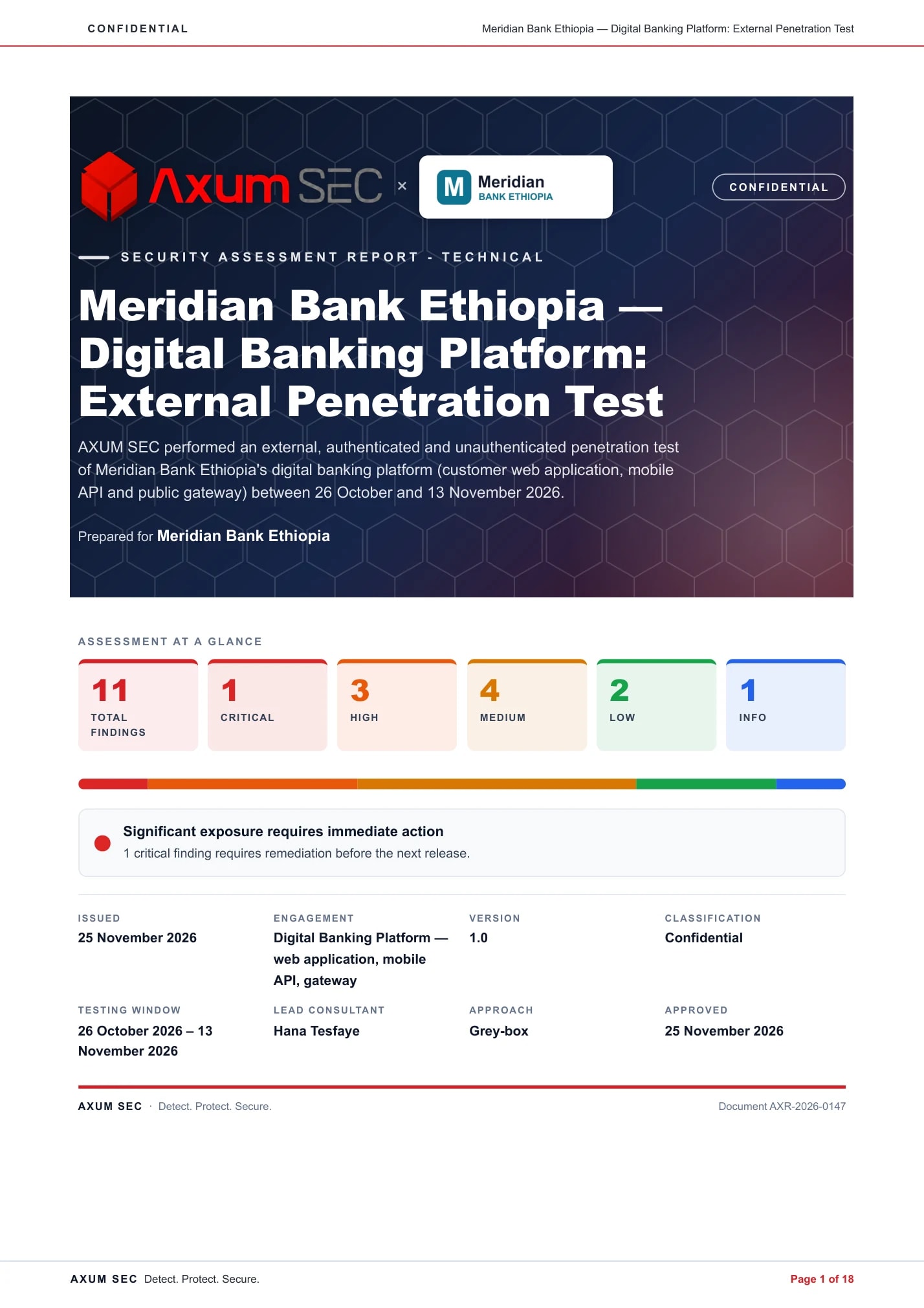
Assessment at a glance
11
Total findings
1
Critical
3
High
4
Medium
2
Low
1
Info
3 of 11 findings already fixed and verified by retest
27%
Inside the report
Read it page by page
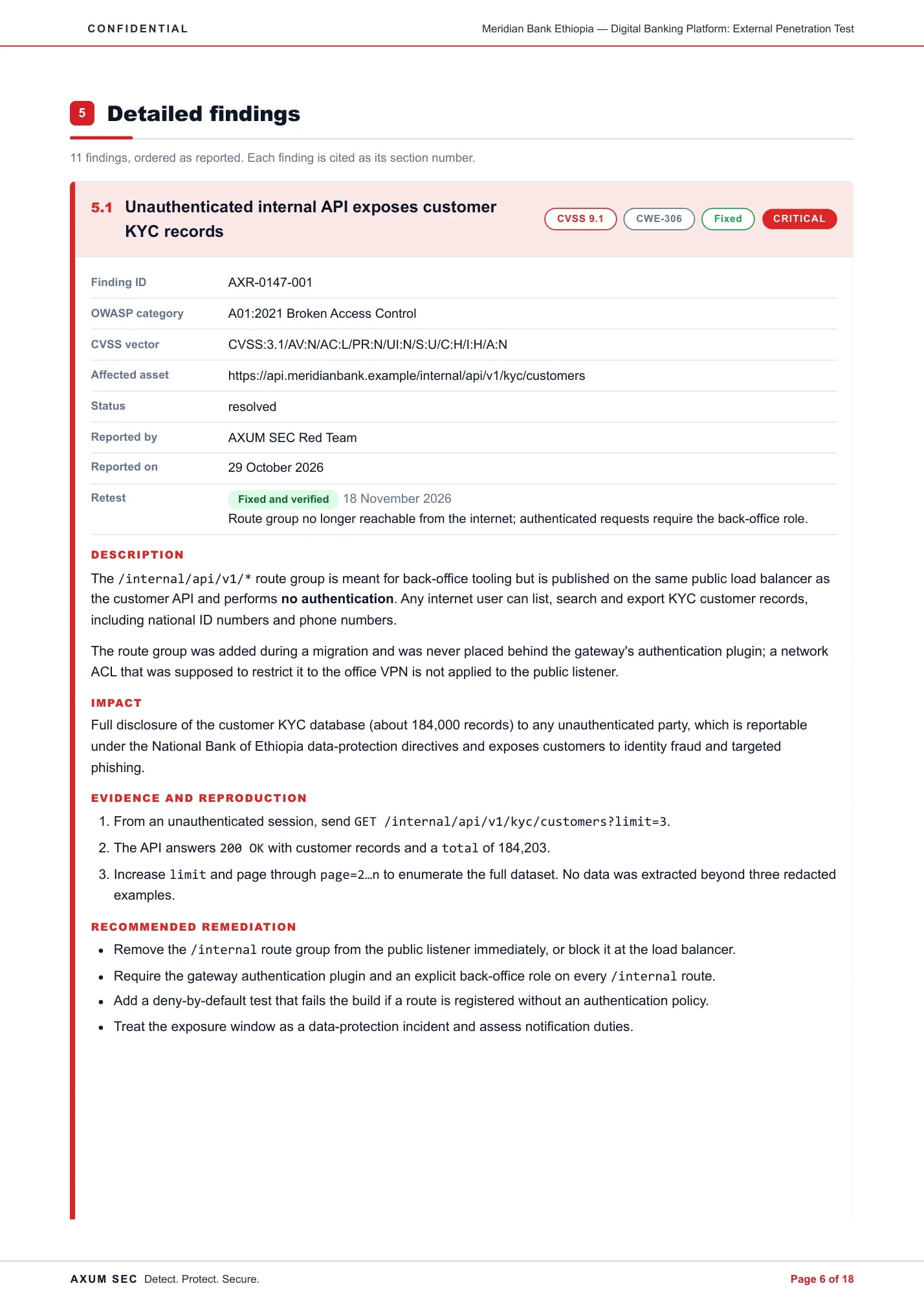
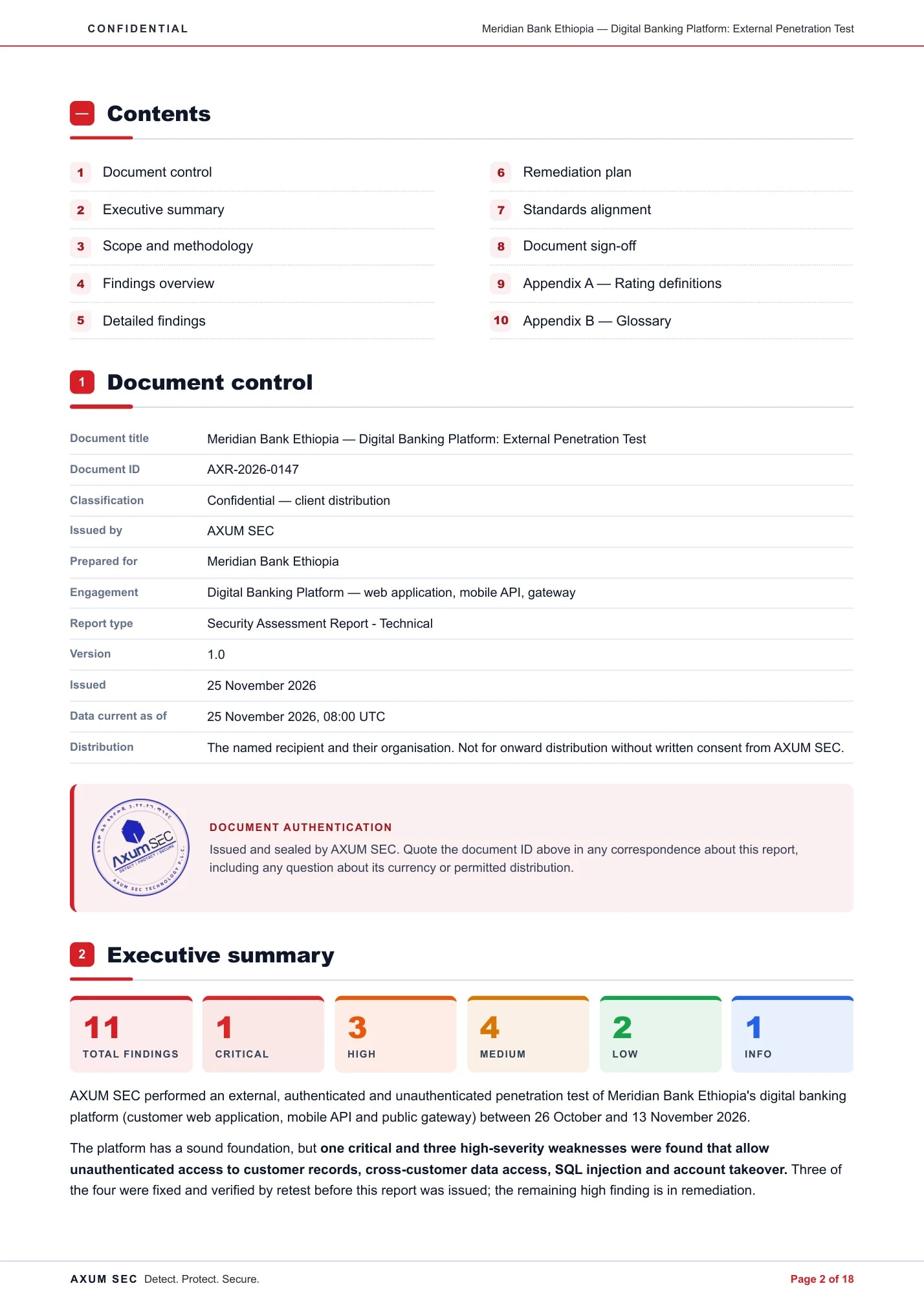
These are real pages from the sample. Pick one to see what it covers, or open it full size.
Page 1 of 18
Who it was prepared for, the scope and approach, the severity count, and the one-line verdict leadership reads first.
Every finding, the same shape
Nothing is reported without proof
Each of the 11 findings follows one structure, so reviewers know where to look and developers know what to do.
Severity and CVSS vector
A rating and a full CVSS 3.1 vector, so the score can be checked rather than taken on trust.
Weakness classification
The CWE and the OWASP Top 10 category, so every finding speaks the same language as your standards.
Description and impact
What is wrong, in plain words, and what an attacker could actually do with it.
Evidence and reproduction
Redacted request and response captures with numbered steps that reproduce the finding end to end.
Recommended remediation
A specific fix for your stack, not a generic best practice.
Retest status
"Fixed and verified" with the date, once a retest has confirmed the fix. Until then it stays open.
The findings
11 findings, from critical to informational
Ordered as reported. In the PDF each one has its own section with evidence and a fix.
| # | Finding | Severity | CVSS | Weakness | Status |
|---|---|---|---|---|---|
| 1 | Unauthenticated internal API exposes customer KYC records | Critical | 9.1 | CWE-306 | Fixed and verified |
| 2 | Broken object-level authorization on account statements (IDOR) | High | 8.1 | CWE-639 | Fixed and verified |
| 3 | SQL injection in transaction search filter | High | 8.8 | CWE-89 | Fixed and verified |
| 4 | Refresh endpoint accepts JWTs with the "none" algorithm | High | 7.5 | CWE-347 | In progress |
| 5 | Profile API returns more personal data than the client displays | Medium | 6.5 | CWE-213 | Open |
| 6 | Reflected cross-site scripting in the transfer receipt page | Medium | 6.1 | CWE-79 | Open |
| 7 | Weak TLS configuration: TLS 1.0/1.1 and CBC / 3DES suites enabled | Medium | 5.9 | CWE-326 | Open |
| 8 | No rate limiting on one-time-password verification | Medium | 5.3 | CWE-307 | Open |
| 9 | Verbose error responses disclose stack traces and internal hostnames | Low | 4.3 | CWE-209 | Open |
| 10 | Missing security headers: CSP, X-Content-Type-Options, Referrer-Policy | Low | 3.7 | CWE-693 | Open |
| 11 | Outdated jQuery 3.3.1 with published advisories (no exploitable path found) | Info | 0.0 | CWE-1104 | Open |
- #1CriticalCVSS 9.1
Unauthenticated internal API exposes customer KYC records
CWE-306Fixed and verified - #2HighCVSS 8.1
Broken object-level authorization on account statements (IDOR)
CWE-639Fixed and verified - #3HighCVSS 8.8
SQL injection in transaction search filter
CWE-89Fixed and verified - #4HighCVSS 7.5
Refresh endpoint accepts JWTs with the "none" algorithm
CWE-347In progress - #5MediumCVSS 6.5
Profile API returns more personal data than the client displays
CWE-213Open - #6MediumCVSS 6.1
Reflected cross-site scripting in the transfer receipt page
CWE-79Open - #7MediumCVSS 5.9
Weak TLS configuration: TLS 1.0/1.1 and CBC / 3DES suites enabled
CWE-326Open - #8MediumCVSS 5.3
No rate limiting on one-time-password verification
CWE-307Open - #9LowCVSS 4.3
Verbose error responses disclose stack traces and internal hostnames
CWE-209Open - #10LowCVSS 3.7
Missing security headers: CSP, X-Content-Type-Options, Referrer-Policy
CWE-693Open - #11InfoCVSS 0.0
Outdated jQuery 3.3.1 with published advisories (no exploitable path found)
CWE-1104Open
How you get your report
From finished test to a report in your hands
Your report is generated from the findings in your own AXUM SEC workspace, so it always matches what your team sees there.
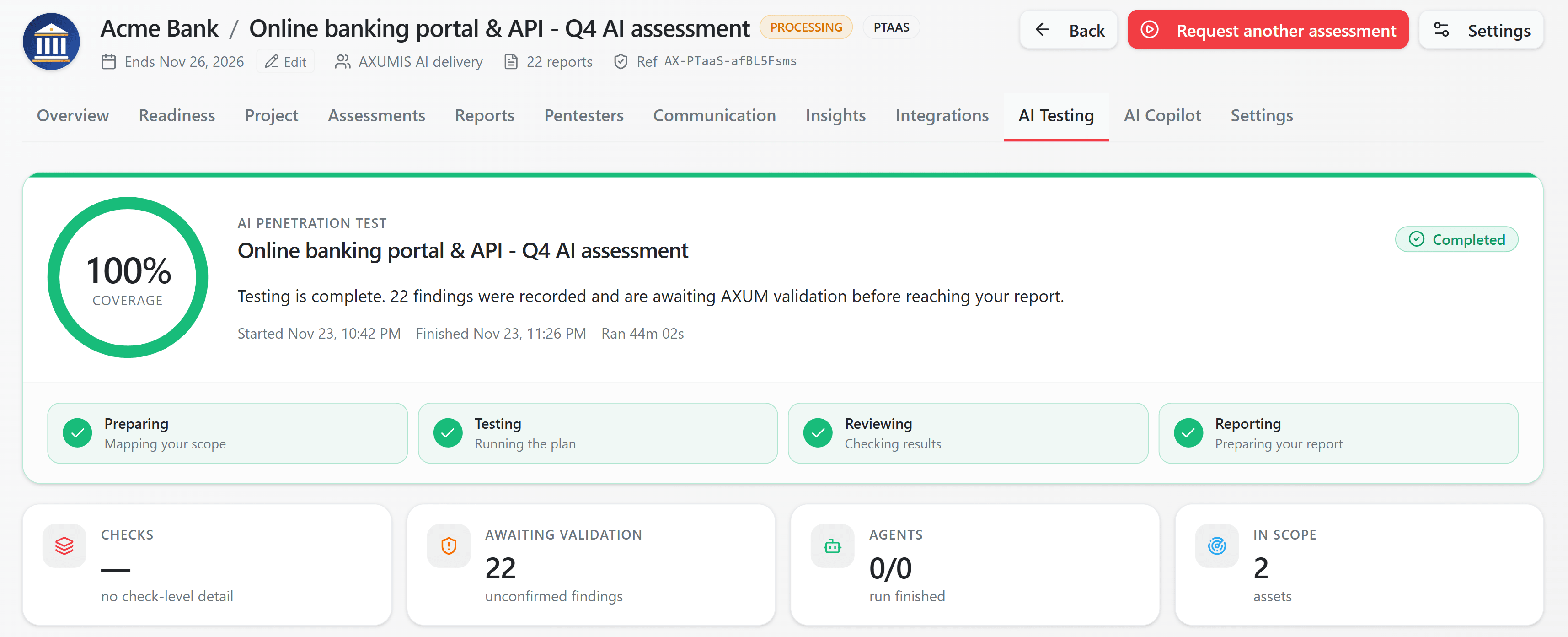
Real screen from the AXUM SEC workspace, on a sample scope.
One report, three readers
Written so each reader can stop when they have what they need
- Pages 1 to 3
Leadership
A verdict in one line, the risk in business terms, what is working, and a plan with clear priorities.
- Pages 5 to 15
Engineering
Every finding with evidence, reproduction steps and the fix, so work can start without a meeting.
- Pages 16 to 17
Audit and compliance
Each finding mapped to OWASP Top 10, PCI DSS v4.0 and ISO/IEC 27001:2022, plus a document ID and sign-off.
The standards mapping is advisory. It points to the relevant requirement; it does not assert compliance.
Questions
About this sample
Short answers about what the report is and how it is produced.
Is this a real customer report?
No. It is a sample for a fictional bank (meridianbank.example), written to show the structure, depth and evidence you receive. It contains no customer data.
Does every finding come with proof?
Yes. A finding is not reported until it can be reproduced. Each one includes evidence and numbered steps, so your developers can see it for themselves.
Do AI-found issues go straight into my report?
No. Findings recorded by the AXUMIS agents are marked as awaiting validation, and nothing reaches your report until an AXUM reviewer has verified it.
Does the report say we are compliant?
No. The mapping to OWASP Top 10, PCI DSS and ISO/IEC 27001 is advisory: it points to the relevant requirement, but it does not assert compliance.
How do I prove a fix worked?
Request a retest from the finding. When it passes, the report records "Fixed and verified" with the date, as findings 1 to 3 do in this sample.
Get a report like this for your own platform
Tell us what you want tested. You get the same structure, the same proof for every finding, and a workspace to fix and retest in.
Want to see the engine behind it? Explore AXUMIS AI pentesting